Furniture is one of the most common things people and businesses ship from Europe to the United States, and one of the easiest to get wrong. It is bulky, often fragile, sometimes made of wood that is subject to plant-health rules, and it needs more than a parcel van at the end of the journey. Here is how the process works from pickup to delivery.
Step 1: Measure and list everything
Freight is priced on space and weight, not on the number of items. Before asking for a quote, list each piece with its dimensions (length, width, height) and approximate weight, both packed if possible. A sofa that measures 220 cm long will take more space once crated. A precise list gets you an accurate price; a vague one gets you a range and possibly a surprise later.
Also note the value of each item and, for new furniture, where it was manufactured. Customs will need both.
Step 2: Choose sea or air
Sea freight is the standard for furniture: it is far cheaper per cubic meter and has no practical size limit. Crossing the Atlantic and clearing customs typically takes several weeks door to door, depending on the ports and inland legs.
Air freight takes days rather than weeks, but it is priced on volumetric weight, which penalizes large, light items like upholstered furniture. It makes sense for a single urgent piece, a sample for a showroom, or high-value antiques.
Step 3: Shared container or full container?
If you are shipping a few pieces or a few pallets, they travel as a less-than-container load (LCL): your goods share a container with other shipments, and you pay for the cubic meters you use. If you are moving a whole household or a large retail order, a full container load (FCL) can be cheaper per item and reduces handling, since the container is sealed at origin and opened at destination. Our guide FCL vs LCL explains where the tipping point usually lies.
Step 4: Pack for the journey, not for the store
Furniture in a container is moved by forklifts, stacked and exposed to humidity changes. Good packing makes the difference between a successful shipment and a damage claim:
- Wrap pieces in moving blankets or foam, then stretch-wrap them.
- Protect corners and legs; remove legs if they unscrew.
- Crate fragile items (glass, marble, antiques) in a wooden crate.
- Use pallets so the goods can be moved by forklift and kept off the floor.
Wooden crates and pallets entering the US must be heat-treated and stamped to the ISPM 15 standard. Untreated wood packaging can be refused at the port. See how to prepare pallets and crates.
Step 5: Prepare the customs documents
Every import into the United States has to be declared. For furniture, you will need:
- A commercial invoice (or a pro forma invoice if the goods were not sold), describing each piece, its material, its value and its country of origin.
- A packing list showing what is in each package.
- For ocean shipments, the importer security filing (ISF), which must be filed before the container is loaded at the port of origin. Your forwarder normally handles it with the information you provide.
Furniture made from certain wood species, or containing materials such as leather or rattan, can be subject to additional rules. Mention the materials in your quote request so they can be checked early.
Step 6: Duties and taxes
Most furniture falls under chapter 94 of the tariff schedule. Many furniture headings have low or zero base duty, but the rate depends on the exact classification and the country of origin, and additional tariffs may apply depending on where the goods were made. Customs fees and, for sea freight, the harbor maintenance fee are added. Our article on import duties explains each line.
Used household goods belonging to a person moving to the US can qualify for duty-free entry under specific conditions. These rules have their own paperwork, so mention it if this is a personal move.
Step 7: Plan the final delivery
Once customs releases the shipment, it still has to reach the door. For furniture, that usually means:
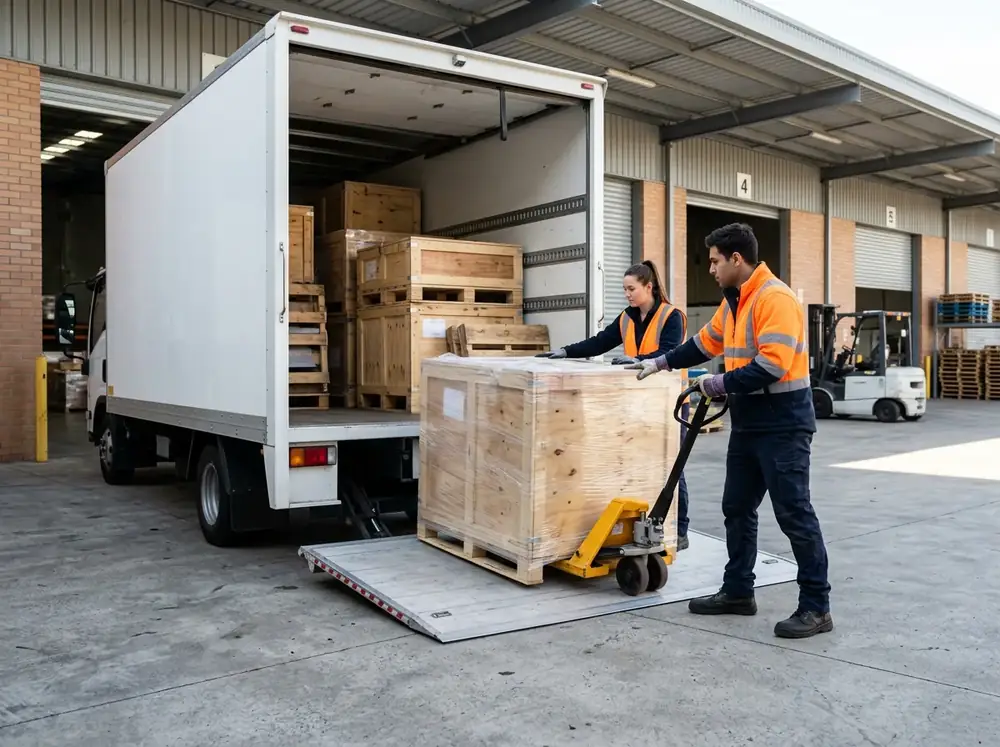
- A liftgate truck if the address has no loading dock (almost every home).
- A two-person crew for anything one person cannot carry safely.
- Inside or room-of-choice delivery if you do not want the pieces left at the door.
Our guide on delivery options for heavy items compares them. Book the delivery window in advance and make sure someone can receive and inspect the shipment.
Step 8: Inspect on arrival
Check every package before signing. Note any visible damage on the delivery receipt, take photos, and keep the packaging until you have unpacked everything. Concealed damage must be reported quickly; the deadlines for KDX shipments are in our Shipping Policy.
Checklist
- Itemized list with dimensions, weights, values and origin
- Mode chosen: sea (LCL or FCL) or air
- Packing with blankets, corner protection, ISPM 15 pallets or crates
- Commercial invoice and packing list ready
- Budget for duties, customs fees and final delivery
- Delivery address details: dock or liftgate, stairs, access
Ready to ship? Request a quote with your list and we will propose the right combination.
This guide is general information, not legal or customs advice. Rules and rates change; check the current requirements for your shipment.